
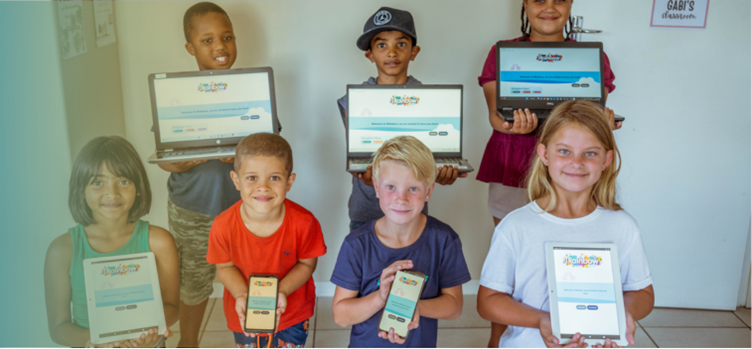
iRainbow has left no stone unturned to ensure that when a child embarks on the iRainbow journey, they: The visionaries from iRainbow decided to update and upgrade their already impressive maths programs for primary and high school learners, long before Covid-19 struck. The future is technology-driven, and the value technology adds to the education of South Africa’s learners is recognised and respected. Hence the drive to ensure that the program remains mostly internet independent and data-friendly to suit users with limited connectivity. This journey started by revisiting the most valuable shareholder in this partnership, the learners. iRainbow provides educational lessons via technology to learners from Grade 0 to Grade 12. So when an upgrade was planned, the planning started with our target audiences in mind: For us, too, this was a valuable learning experience. The following three major considerations were used as motivation and inspiration to develop a new, trendy, dynamic, and attractive product:
1. Stages Of Development For Learners In Primary And Secondary Schools:
We went back to the “father of childhood development”, Jean Piaget. Piaget’s four stages of development were revisited to understand and learn about our most important partners.
We focused on the basic development of the latter two stages of Piaget’s theory to get an understanding of the age groups seven to eleven (concrete operational stage) and the group aged twelve and older (formal operational stage).
Piaget’s Informed That Children Are Not Merely “Little Adults” But Are Capable Of Making Sense Of Their Surroundings In Their Own Way, And Can Solve Problems In Their Own Time, Space And Manner.
For the age group seven to eleven, the following facts were taken into consideration:
The older age group (formal Operational Stage), illustrates the following characteristics:
With the above in mind, we also learnt that learners avoid being “wrong” and do not take chances.
Are VERY sensitive socially and almost always avoid situations where they may be wrong. This has a direct influence on their confidence and skills to solve mathematical problems.
This serious problem eventually has a negative impact on their ability to do maths and grow their skills and their self-belief.
- Children start thinking logically,
- Make sense of their environment (short glass is equal in volume to tall narrow glass)
- Organise their thinking more logically, although still very concrete (say things as it is!)
- Starts reasoning from specific things to a more general principle.
- Start thinking more abstractly and begin reasoning about hypothetical problems.
- Develops abstract thoughts.
- Begin thinking in terms of moral, philosophical, social, and ethical issues of life.
- Deductive logic develops from general to specific areas of application.
2. South Africa’s Mathematics Crisis
Secondly, it is common knowledge today- that South Africa struggles to provide enough students who passed Grade 12 and can stand their ground on university level.Much of the blame is passed on to teachers who are not qualified to teach maths. On 24 Feb 2021 the South African media reported the following after the annual Grade 12 results were announced:
“Of The 233 315 Candidates Who Wrote Mathematics, 125 526 Passed, Resulting In A 53.8% Pass Rate, Down From 54.6% In 2019. “
“Half Of All Matrics Who Wrote Maths Fail It Each Year”, Bongani Nkosi (The Star, 24 Feb 2021).
3. Digital Learning Trends And Best Practices
With all the basic principles of development in mind, the IRainbow team took ahard look at current trends on education with technology. What are learnersinterested in? Why do some programs get attention while others don’t? What willmotivate our target groups intrinsically?What is important to parents today?Howcan we avoid the self- destructive conversation that learners often have withthemselves? How can we delete the thought that they can not do maths?First, by looking at what do today’s learner love doing when learning.How can they build confidence and self-worth, even when struggling withmathematics?
The following trends in digital learning were considered:
The new iRainbow product is based on research, recognizing that teachers try their best with what they have and can do, and that today’s learners want to use technology, and want to be challenged by it. iRainbow provides a New Dawn for it’s customers and most importantly almost guarantees a child with mathematical confidence and perseverance to try, and try again. To fail and even fail smarter, before tasting success after success. To enjoy the journey and grow into a confident South African student
Related Posts
- To have fun;
- Work in private, yet not alone;
- Make mistakes and learn from them;
- Competition causes pressure and motivation to achieve success;
- Repeat at will;
- Explanations and help is available when needed.
- Short digestible exercises, to keep momentum;
- Diverse and ranges of exercises with various question types;
- Confidence is more important than being correct and high scores;
- Foundations are formed and revisited.
- Directly related with SA CAPS curriculum.
Help Your Child Succeed
iRainbow provides gamified activities and a free AI Tutor - all aligned with CAPS and IEB curricula. 15,000+ video lessons available as an add-on. One subscription gives access to all subjects and all grades.